
A smart home that stops working is more frustrating than an ordinary house that never worked that way. The lights will not respond to the keypad, the app says “unable to connect”, or the whole system goes quiet after a storm.
Before you call anyone, there are some smart home troubleshooting checks that are safe for any homeowner to run. A fair share of the time, one of them fixes it. When it does not, you will at least be able to tell whoever you call exactly what is going on, which saves time on site.
This guide is written for wired and hybrid systems such as C-Bus, Dynalite, KNX, Control4 and Savant, and for the apps that sit on top of them. If you are not sure what you have, our guide to what a smart home actually is explains how the pieces fit together.
Smart home troubleshooting: work from the top down
Most smart homes have the same layers stacked on each other:
- Power to the switchboard, controllers and network gear
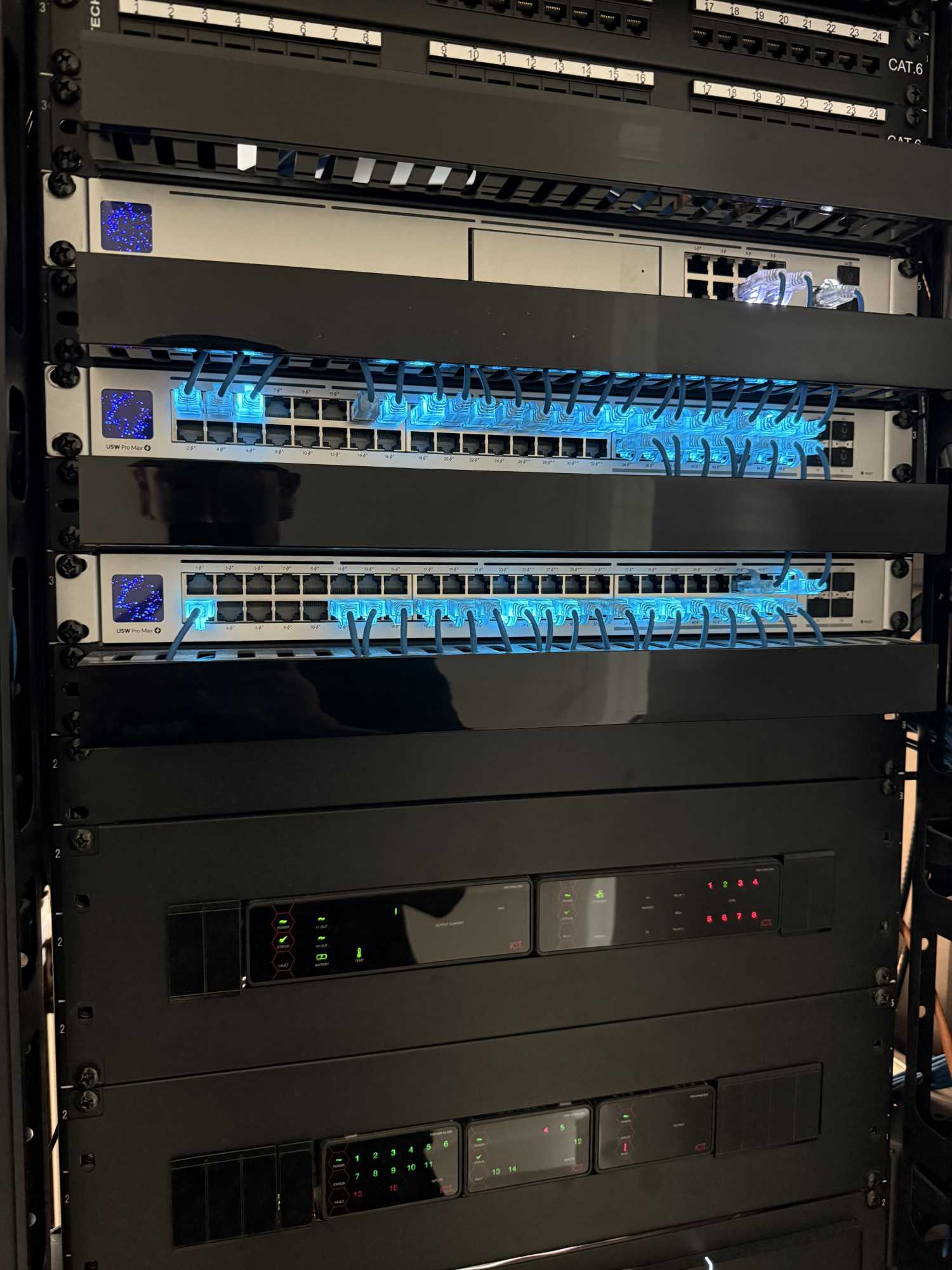
- The network: modem, router, switches and Wi-Fi
- The controller or processor that runs the programming
- The devices: dimmers, relays, keypads, sensors, cameras
- The app on your phone or wall touchscreen
A fault high in the stack takes out everything below it. So start at the top.
Check 1: Is it everything, or one thing?
This one question narrows it down fast.
- Everything stopped at once: think power, the network or the main controller.
- One room or one type of device: think a single dimmer, relay, keypad or circuit.
- Only the app has stopped, but the wall switches still work: think network, internet or the app itself.
On most wired lighting systems, the keypads on the wall talk to the dimmers directly over their own control cable. If the keypads still work and only the app is dead, the lighting system itself is probably fine.
Check 2: Power at the switchboard
Look at your switchboard for a tripped breaker or safety switch (RCD). Storms and power surges trip them regularly, and automation equipment is often on its own circuit.
If something has tripped, reset it once. If it trips again, leave it off and call a licensed electrician. A circuit that keeps tripping is telling you something, and switchboard work in NSW is for licensed electricians only.
Do not remove covers or touch anything inside the switchboard.
Check 3: The internet, versus the network
These are not the same thing, and the difference matters.
If your internet is down, you will usually lose remote access (controlling the house from outside) and anything that relies on a cloud service, such as voice assistants. Inside the house, a properly set up system should keep working on the local network.
Test it: can you browse the web on the home Wi-Fi? If not, the problem is your internet or router, not the automation.
Check 4: Did anything change on the network recently?
This is one of the most common reasons a smart home suddenly goes offline, and it is easy to miss because it happened weeks ago.
- A new modem or router from your internet provider
- A changed Wi-Fi name or password
- Someone “tidying up” the network cupboard
Automation controllers are usually set to a fixed address on your home network. A new router can use a different address range, and the app then has no idea where to find the controller, even though nothing is actually broken. If the problem started around the time of a network change, say so when you call. It usually points straight to the fix.
Our guide to whole-home Wi-Fi explains why the network is the foundation everything else sits on.
Check 5: Restart in the right order
Restarting helps, but only in the right order. Restart things out of order and devices can come up before the network is ready, then fail to connect.
- Modem and router first. Wait until the internet is back.
- Then any network switches in the comms cupboard.
- Then the automation controller or processor.
- Finally, close and reopen the app.
Give each step a few minutes. If you are not sure which box is the controller, do not guess. Leave that step for the service visit.
Check 6: Batteries
Wireless sensors, remotes, door locks and some keypads run on batteries, and they rarely warn you properly before they die. If a single motion sensor, remote or lock has stopped responding, a fresh battery is the cheapest fix there is.
Check 7: The app
- Log out and back in. Sessions expire.
- Check for app updates. A phone software update can break an older app until the maker catches up.
- Check the app is still supported. Manufacturers do retire older apps and controllers. If yours has been discontinued, the answer may be an upgraded controller rather than a repair.
Check 8: Was there a power outage?
Wired lighting systems can behave oddly after an outage: lights come on at full brightness, scenes stop working, or some circuits stay off. There is usually a specific reason, and a specific fix. We cover it on its own page: lights not working after a power outage.
The one thing you should never do
Do not factory reset the controller, the processor or any keypad.
On most professional systems, the programming (every scene, schedule, keypad button and name) lives in the devices and in a project file held by whoever programmed it. A factory reset can wipe it. If nobody has a copy of that file, every scene has to be rebuilt from scratch.
The same goes for letting a general IT technician “reset the network” around the automation equipment, or unplugging and re-plugging cables in the comms cupboard to see what happens.
When to call someone
Call when:
- Everything has stopped and the power and network look fine
- A breaker or safety switch keeps tripping
- A whole room or circuit is dead
- The app cannot find the controller after a network change
- Your original installer is no longer around
That last one is more common than it should be. If the company that installed your system has closed, moved on or stopped answering, we work on systems other people installed.
Frequently asked questions
Why has my smart home stopped working?
The most common causes are a power trip, an internet or router problem, a network change such as a new modem, flat batteries in wireless devices, or an app that needs updating. Working from power, to network, to controller, to devices narrows it down.
Will my lights still work if the internet goes down?
On a properly set up wired lighting system, yes. The wall keypads talk to the dimmers over their own control cable. You lose remote access and cloud features until the internet is back.
Should I factory reset my smart home controller?
No. A factory reset can erase the programming, and if nobody has the project file every scene and schedule has to be rebuilt. Call someone who can back it up first.
My installer has gone out of business. Can someone else fix my system?
Usually, yes. Mainstream systems such as C-Bus, Dynalite and KNX are serviced by independent integrators. Having the project file and passwords makes it much faster, but a system can often be recovered without them.
How long does a smart home repair take?
Simple faults, such as a failed dimmer or a network address change, are often fixed in a single visit. Faults where the programming has been lost take longer, because it has to be rebuilt.
Related reading
- C-Bus Not Working? Common C-Bus Faults and What They Usually Mean
- Dynalite Not Working? Common Philips Dynalite Faults Explained
- CCTV Not Recording? Why Home Security Cameras Stop Recording
- Why Is My Home Alarm Beeping? Common Causes and Fixes
- Smart Home Upgrade: Repair or Replace an Ageing System?
Still not working? Call us.
We fix smart home faults across Sydney’s Northern Beaches, Eastern Suburbs, North Shore and Northern Suburbs, on C-Bus, Dynalite, KNX and more, including systems we did not install.
Sam Doolan · 0479 122 450 · sam@hyperautomation.com.au
Or see our smart home repair page.